Why the Steve Adamko Interior Design School Is Different and Distinctive
Interior Design Is More Than Creating a Beautiful Room
Most interior design education begins with a fairly straightforward objective: teach students how to create beautiful rooms. That is certainly part of interior design, but it is not the whole of it. A room can contain beautiful furniture, sophisticated finishes, carefully selected colors, and impressive architectural details and still fail to create the feeling that distinguishes an exceptional interior from an ordinary one. The difference lies in something more difficult to define and much harder to teach: ambiance.
This distinction is at the heart of the Steve Adamko Interior Design School. Steve Adamko believes that great interior design is never simply about The Look. It is about The Look and The Ambiance working together. The Look is what the eye sees—the architecture, furnishings, materials, colors, proportions, lighting, and composition of a room. The Ambiance is what the occupant experiences—the atmosphere, emotion, comfort, energy, intimacy, warmth, drama, or serenity that the room creates. When these two elements are successfully brought together, a room becomes more than a collection of well-chosen objects. It becomes an environment.
Understanding that distinction requires more than learning decorating techniques or memorizing design terminology. It requires learning how to see. It requires judgment, experience, and an understanding of the principles that have guided successful architecture and interior design for centuries. That is the foundation upon which Steve Adamko has built his school.
Learning Directly From Steve Adamko a Practicing Master Interior Designer; Founder of the Steve Adamko Interior Design School

The Steve Adamko Interior Design School is unusual because its educational philosophy is inseparable from the life and professional experience of the person teaching it. Steve Adamko is the founder and sole instructor of the school, bringing more than four decades of experience to the classroom. He founded Spectrum Interiors in 1982 and has spent his professional life designing residential environments for discerning homeowners.
His experience also extends well beyond the traditional boundaries of interior design. Steve is a licensed builder, custom furniture designer, and residential lighting designer. Each discipline has given him a different perspective on the interior environment, and those perspectives inform the way he approaches design as a whole. He understands not only how a room should look, but how it is constructed, how furniture affects its proportions and function, and how lighting can fundamentally change the way an interior is perceived.
Steve is also the Creator and Voice of the Interior Design Beat podcast which is Ranked #23 of the top 49 interior design podcasts globally per Feedspot.
That breadth of experience is important because exceptional interiors do not exist in isolated categories. Architecture affects furniture. Furniture affects circulation. Lighting affects color and material. Construction affects what is possible. Proportion affects comfort and visual harmony. A decision in one area can influence everything else in the room. A designer who understands only one piece of that equation may produce attractive results, but a designer who understands how the pieces interact has a much greater ability to create something truly cohesive.
Steve’s career has also extended into education and media. He is the host and voice of the Interior Design Beat podcast and the creator of the DesignAmbiance YouTube channel. Through those platforms, as well as through his school, he has developed a philosophy centered on helping people understand what actually makes an interior successful.
The result is an educational experience that is difficult to replicate because it is based not on a generic curriculum, but on one designer’s accumulated body of professional knowledge, observation, experimentation, and judgment.
A Principle-Based Approach to Interior Design
Trends are temporary. Principles are not.
This simple idea separates the Steve Adamko Interior Design School from much of the design education available today. Styles change constantly. What is considered fashionable today may look dated a decade from now, while many of the greatest interiors in history continue to look compelling generations after they were created. Their enduring quality does not come from their adherence to a particular trend. It comes from the underlying principles upon which they were designed.
Scale, proportion, balance, harmony, rhythm, emphasis, light, human comfort, and visual order are not passing fashions. They are fundamental tools for creating environments that feel coherent and intentional. They have been used by architects, designers, artists, and craftsmen for centuries because they address something deeper than style. They address how human beings perceive and experience space.
This is why the Steve Adamko Interior Design School can be described as a principle-based interior design school. Steve teaches students to understand the ideas beneath the finished room. Rather than simply showing students what is fashionable, he teaches them to understand why something works. Once those principles are understood, they can be applied to traditional interiors, contemporary interiors, transitional interiors, or virtually any other aesthetic approach.
The advantage of learning principles is that principles remain useful long after a particular trend has disappeared. A student who understands proportion can evaluate a room regardless of its style. Someone who understands lighting can make intelligent decisions whether the interior is modern or traditional. Someone who understands balance and visual hierarchy can recognize why a composition feels right even when the individual elements are completely different from those found in another room.
That is a far more enduring education than simply learning to reproduce the look of the moment. This is must more than you learn in a typical interior design school.
The Difference Between Information and Judgment
There is no shortage of interior design information. Anyone with an internet connection can find articles about color theory, videos about decorating, software tutorials, product recommendations, and countless opinions about what should or should not be done in a home. Information has become abundant and inexpensive.
What remains scarce is judgment.
An experienced designer can enter a room and begin evaluating it almost instinctively. Why does the room feel uncomfortable? Why does one piece of furniture seem too large? Why does the composition feel unbalanced? Why does the lighting make the space feel flat? Why does the room look expensive but fail to feel sophisticated? What element is missing? What needs to be removed rather than added?
These are not questions that can always be answered by following a checklist. They require an understanding of relationships and an ability to recognize the difference between what a room is and what it could be.
That ability comes from experience.
Steve Adamko’s approach to education is therefore not simply about transferring information from teacher to student like most interior design schools. It is about developing the student’s ability to observe, analyze, and make informed design decisions. The objective is to help students begin seeing interiors through the eyes of an experienced designer—to develop the habit of asking not merely, “Do I like this?” but, “Why does this work?”
That change in perspective can be transformative. Once you begin to understand the principles behind a successful interior, you no longer experience rooms in quite the same way. You start noticing proportion, scale, light, rhythm, balance, and visual relationships that previously went unnoticed. You begin to understand why certain spaces feel effortless while others feel strangely unresolved.
That is the beginning of design judgment.
A Modern Expression of the Master-Apprentice Tradition
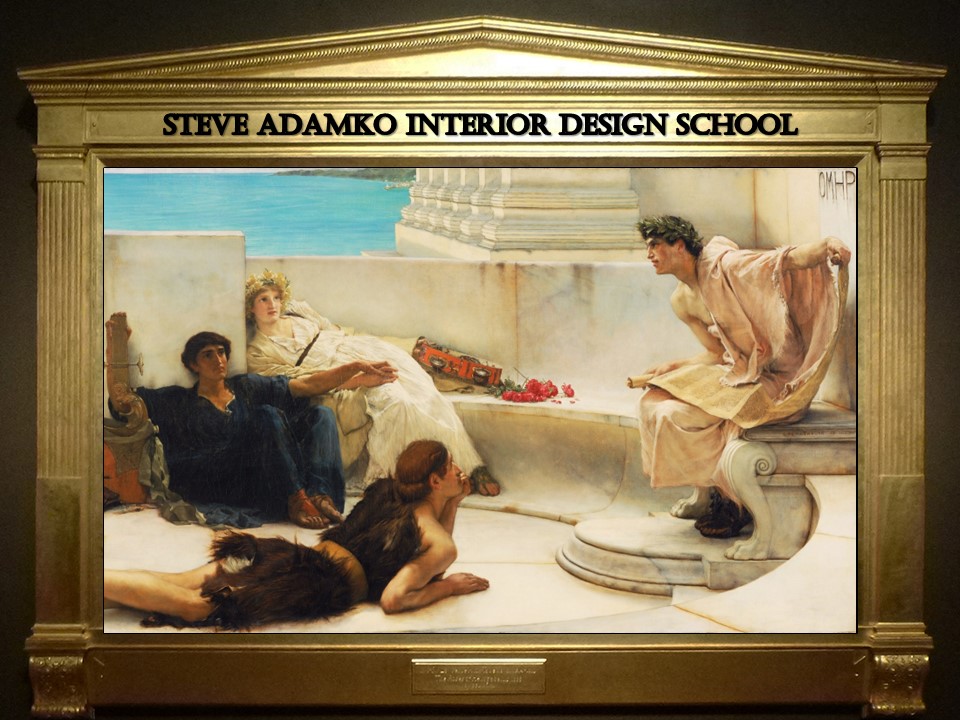
The Steve Adamko Interior Design School is, in many ways, a modern interpretation of an old idea: the master-apprentice relationship.
Long before online education, great artists, architects, craftsmen, and designers learned by studying directly with experienced masters. The apprentice did not simply acquire technical information. He or she observed how the master thought, how problems were approached, how decisions were made, and how quality was recognized. Over time, the apprentice developed not only skills, but judgment.
Steve’s interior design school brings that philosophy into the modern world.
The education is delivered online, but the underlying relationship is remarkably traditional. Students are learning directly from the person who developed the philosophy, rather than moving through a large institution where individual subjects may be taught by different instructors with different approaches. The school is intentionally centered on Steve’s own experience and understanding of interior design.
That makes the interior design school less about obtaining a credential and more about gaining access to a body of knowledge that has been developed through a lifetime of professional practice.
Designed for the Sophisticated Homeowner
Although interior designers, decorators, design enthusiasts, and architecture enthusiasts can benefit from Steve’s teachings, the interior design school’s audience extends well beyond people who intend to pursue interior design as a profession.
Many homeowners have reached a point where they want to understand their homes at a deeper level. They may own an architecturally significant property, be undertaking a major renovation, be furnishing a new home, or simply have a strong appreciation for exceptional design. They may work with professional designers and builders, but they want enough knowledge to understand the decisions being made and to participate intelligently in the process.
For these people, the appeal of the Steve Adamko Interior Design School is not a career change. It is knowledge and discernment.
An affluent homeowner may not want to become an interior designer, but that does not mean he or she cannot benefit enormously from learning how a master designer evaluates a room. Understanding proportion can make it easier to evaluate furniture. Understanding lighting can change the way a renovation is approached. Understanding balance and visual hierarchy can make the difference between a room that feels merely furnished and one that feels finished.
The underlying promise is simple: understand your home the way a master designer does.
That is a different proposition from traditional career-oriented design education, and it speaks directly to people who value quality, sophistication, and a deeper understanding of their surroundings.
The Look and The Ambiance
At the center of Steve Adamko’s philosophy is the relationship between The Look and The Ambiance. This is what sets the Steve Adamko Interior Design School apart from all others!
The Look is immediately accessible. We can see the furniture, the architecture, the colors, the finishes, the artwork, and the lighting fixtures. These are the visible ingredients of an interior and are often the things people focus on when they talk about design.
Ambiance is more elusive. It is the feeling generated by all of those elements working together. It is why one room feels intimate and another feels expansive. Why one feels welcoming and another feels formal. Why one feels calm and another feels energetic. Ambiance is not created by a single object. It emerges from the relationship between the elements of the space.
A designer who understands only The Look can create a room that photographs beautifully. A designer who understands both The Look and The Ambiance can create a room that people actually want to experience.
That distinction becomes especially important in residential design, where the ultimate purpose of an interior is not to exist as a photograph. It is to support human life. People live in these spaces. They gather, entertain, relax, work, eat, celebrate, and make memories in them. A successful interior must therefore satisfy both the eye and the human experience. That is why Steve started his namesake interior design school. Steve wanted the experience to be above other interior design schools in very unique and distinctive ways.
This is where Steve’s combination of design, construction, furniture, and lighting experience becomes particularly valuable. He approaches the interior as an integrated environment rather than a collection of separate design decisions. Most interior design schools do not incorporate all this in an integrated and orchestrated way.
What Makes the Steve Adamko Interior Design School So Difficult to Replicate?
There are many things an online school can offer. It can offer video lessons, downloadable materials, memberships, certificates, software instruction, and an organized curriculum. Those are valuable tools, but they are not what makes one particular educator unique.
Steve’s distinction lies in the experience behind the teaching.
More than four decades as a practicing interior designer cannot be manufactured overnight. Spectrum Interiors, established in 1982, represents a professional history that competitors cannot simply duplicate. Neither can they reproduce Steve’s individual design philosophy, his body of work, his experience as a licensed builder, or his additional expertise in furniture and residential lighting design.
They cannot reproduce his voice and perspective developed through the Interior Design Beat podcast and DesignAmbiance. Most importantly, they cannot reproduce the judgment that comes from decades of making real design decisions for real clients and living with the results.
This is why the interior design school should not be thought of merely as another online interior design course or curriculum.
It is an opportunity to learn directly from a designer whose life’s work has been devoted to understanding the relationship between design and human experience.
Interior Design Education for People Who Want to See More Clearly
Ultimately, the Steve Adamko Interior Design School is about changing the way people see.
It is about moving beyond the endless cycle of trends, products, and decorating advice and discovering the principles that make an interior successful regardless of fashion. It is about developing the ability to walk into a room and understand what you are seeing. It is about learning to distinguish between something that is merely attractive and something that is genuinely well designed.
For the homeowner, that knowledge can lead to greater confidence and better decisions. For the designer or decorator, it can deepen professional judgment. For the design enthusiast, it can transform an appreciation of beautiful interiors into a genuine understanding of why they work.
The school represents a return to something that has become increasingly rare in modern education: learning directly from an experienced master whose knowledge has been accumulated through decades of practice.
Steve Adamko does not teach simply to help students create rooms that look good. He teaches them to understand the principles behind exceptional interiors and, ultimately, to understand the relationship between The Look and The Ambiance.That is the difference between learning information about interior design and learning to think like an interior designer. And that is the purpose of the Steve Adamko Interior Design School.
Contact Steve Adamko at Spectrum Interiors at 269-888-2049 (Landline)